
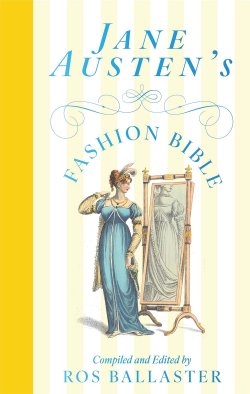
Placing excerpts from beloved novels such as Emma and Pride and Prejudice alongside her own commentary and gorgeous fashion plates from Regency publication La Belle Assemblée, Ros Ballaster tells “a story of Austen’s developing style as a writer, alongside the changing styles of fashion” in Jane Austen’s Fashion Bible.
What prompted your choice to move in chronological order through Austen’s life/work?
I experimented with different ways of organizing the chapters: by activity (riding, traveling, playing music), by place (town or country) or by season. For a while I thought of looking for fashion plates that illustrated different stages of women’s lives—girlhood, maturity, older age—but of course fashion journals then, as now, concentrate on young women thought to be at the height of their powers of attraction: uniformly slender and elegant. So too does Austen: Children and older women are incidental to the plots, and the stories are told through the consciousness of young marriageable women. I wanted, especially for readers who might not (yet) know their way through all of Austen’s works, to tell a story of Austen’s developing style as a writer, alongside the changing styles of fashion from those of her own youth in the early 1790s through to her mature years of the late 1810s. Occasionally I managed to find an exact correspondence in the date of a fashion and the date of the action in a work—such as the fashion plate published end of May 1814 that I used to illustrate Emma at the ball in the Crown Inn at Highbury, which is dated in the novel to the same month and year. But this was not always possible, and the most important choice was to find a striking plate that served to visualize well a key moment in a work in which an aspect of dress was significant in the plot or representation of character.
“Her heroines’ unselfconscious elegance proves their authentic value.”
How do visual mediums like fashion deepen our understanding of an author’s written world?
I think they allow us a way of quickly perceiving relationships and their dynamics in ways that can complement and supplement Austen’s capacity to communicate the same things in short phrases and carefully balanced sentences. Film, television and screen entertainment have meant that we tend to think through visual triggers more than literate people of the Regency era did. The print technologies of illustration were developing rapidly in the period though and were swiftly turned to find ways of giving readers ways of visualizing dress in fashion journals such as La Belle Assemblée. Austen’s shorthand ways of communicating character often rest on what she has them say about dress, although she does not often describe exactly what they are wearing nor their appearance. Fashion plates themselves often tell little stories about not just what women are or should be wearing, but also the relationships between the different figures portrayed, using contrasts in style and color: I think of the plate that shows three girlish figures with the ribbons of their bonnets intertwining that I chose to represent the Bennet sisters walking in the town of Meryton.
Do you think this book would help contemporary readers think about fashion more deeply while reading novels set in the present day?
I would hope so. Readers will notice that fashion can be playing a part in the discourse of the novel without being explicitly or minutely described, just as it is in Austen. Contemporary “chick lit” is often full of references to brands, and heroines prove themselves through having a kind of natural “taste” by comparison with the vulgar buying habits of those who impede their progress toward romantic fulfillment. Austen does something rather more subtle, condemning women from different ends of the social spectrum—Nancy Steele in Sense and Sensibility who comes from comparative poverty and Augusta Elton in Emma who enjoys extreme wealth—through their preoccupation with superficial appearance. Her heroines’ unselfconscious elegance—just the look La Belle Assemblée saw its readers as aspiring to—proves their authentic value.
What is one of your personal favorite Regency styles or trends?
I am an enthusiastic coastal swimmer, so I was especially taken with the seaside outfits. Especially designer Mary Ann Bell’s 1814 invention of a “sea-side bathing dress” which “enables a lady to dress herself in a few minutes without assistance” and “prevents the chance of taking cold by long delay in dressing.” The “bathing preserver” was made of a light silk with a detachable cap “to keep the head dry” and could easily be carried in a “tasteful oiled silk bag” like a reticule. It meant that female bathers were relieved from “the nauseous idea” of wearing those bathing coverings that were rented from the guides at the sea shore. Mary Ann Bell advertised the preserver in fashion plates for La Belle Assemblée, and undertook to be at seaside resorts in the summer to sell her wares from her basket.
As an expert on all things Austen, what cultural medium besides fashion would you say most influenced Austen’s work?
I would say music. Her older sister, Cassandra, was (like the older sister, Elinor, in Sense and Sensibility) the visual artist. It gives a different light on the critical (perhaps self-critical) perspective on Marianne in Sense and Sensibility when we learn that Austen was, like her, an accomplished pianist and enjoyed singing: We can see her handwriting in the Austen family music books that have been digitized and made available online. The Austens’ fascinating cousin, Eliza de Feuillide, who married Jane’s favorite brother, Henry, was a harpist like Mary Crawford in Mansfield Park. We can think of Austen’s works of fiction in terms of the organizing elements of music: melody, harmony, rhythm, texture, form, dynamics, tempo and timbre all work together to make a dynamic whole.
Read our review of ‘Jane Austen’s Fashion Bible’ and see our other picks for literary gifts.
You show how style, cut and fabric could indicate societal norms in the Regency. Did color ever play a part in this aspect of fashion?
Yes, absolutely. Dyes were expensive and pigments not often colorfast, which might explain the fondness for shades that could fade more attractively: yellow, green (“American” green was a new discovery for me, a light apple), rose, blue and light purples. Color was also useful if you wanted to keep up with trends but were less well-heeled. Rather than commissioning a new outfit, you could refresh older items with new accessories and trimmings of different shades. La Belle Assemblée always comments on the colors of the season: In August 1812, when remarking on what is happening with hats in “Parisian Fashions,” the editor observes that they are commonly ornamented at the front with “flowers, or plumes,” and that “none but white feathers or bunches of them of mixed colors, used to be worn, but at present, they are worn all red, all yellow, or all blue.” In a letter to her sister, Cassandra, on Dec. 18, 1799 Jane refers to adapting a cap using the cawl (the body of the hat that covered the hair)from Cassandra’s black velvet bonnet and replacing its “black military feather” with a “coquelicot” one—that is a fiery red-orange like a poppy—which is “to be all the fashion this winter.”
Costuming played a vital role in hit adaptations like Pride & Prejudice (2005) and Emma. (2020). Do film adaptations do Regency era fashion justice?
Actually, working on this book persuaded me that they do. It had been my opinion that screen adaptations since the groundbreaking BBC 1995 series gave us fashion that was a little too free and easy, a little too modern. But looking at the fashion plates in La Belle Assemblée, you can see just that tall, flowing silhouette, adapting to the new softer and fluid materials of muslin and silk imported from China and India. They are of course costumes that suit “model” bodies and the impossibly thin bodies of actresses we see on our screens. You need a lot of support and architecture to put together a costume for a more comfortable body (such as that of the actress Miranda Hart who took the part of Miss Bates in the 2020 film of Emma.). I follow the consensus in preferring the costuming in that adaptation, which was put together by designer Alexandra Byrne. It was an explosion of color that overturned the trend to drown women in white muslin and bury men in black boots and long dark overcoats. No surprise, perhaps, given that the director, Autumn de Wilde, had a portfolio of fashion photography and music videos before she made the film. Especially clever is the color-coding by character: Emma’s pastels and yellows, the eye-exhausting orange of Augusta Elton’s visiting gown and the glorious floral housecoat of Mr. Woodhouse that genuinely brings the garden into the home!
While it’s not an Austen adaptation (which explains the weakness of the dialogue!), I want to mention the poptastic colors and dramatic fashions of the Bridgerton series, especially season two, which brings in wonderful glowing gemstone colors associated with the Indian subcontinent. One of the things I found out in the course of my research was that paste jewelry was especially popular in Georgian society in England. This was made with an imitation stone that was hand-faceted, hand-cut, metal-polished and of a high lead content. All that evidently fake and blingy neck and armwear on show is then thoroughly in period. It puts a new slant on the phrase “diamond of the season.”
Author photo of Ros Ballaster by Keiko Ikeuchi.