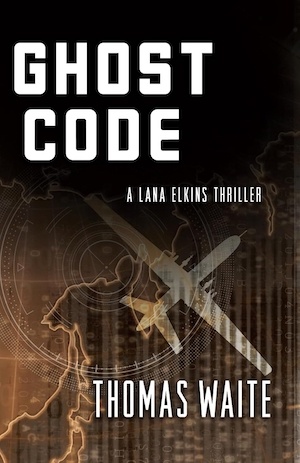

If there were a term (and there probably is) for people in love with AI, analogous to the gearheads who doted on cars in the 1950s and 60s, Thomas Waite’s new cyberthriller Ghost Code would be right up their alley. It stretches the possibilities of ‘how tech stuff can go wrong’ up to and even a bit past the realm of the credible. Cutting-edge as some of the book’s technology may be, the real story is about one person’s reckless and seemingly insatiable desire for power, which is achingly familiar in the crime fiction world.
The story is told in short chapters from the points of view of multiple characters. They can be found in the National Military Command Centre (NMCC) of the US Department of Defence, in high-ranking military posts in Taiwan and China, in the offices of the military platform developer Seto Systems, located outside San Diego, on ships facing off in the Taiwan Strait, and in San Francisco’s seedy Tenderloin district.
Key people in all those locations are increasingly aware that something seems to be amiss with Seto Systems’ flagship AI-powered security program ARELL, acronym for ‘autonomous real-time engagement and logistics lattice.’ It’s a military decision-making platform that has the potential to take humans and human error out of the picture. ARELL has gradually been integrated with various countries’ military surveillance systems to indicate threats and the movement of warships, planes, missiles and troops throughout the world. But now ARELL is getting weird. It’s showing attacking planes headed for Taiwan; Taiwanese and Chinese monitoring systems show the exact same thing, even though, in theory, they aren’t linked. Then the attackers disappear from the computer screens. Are they there, or aren’t they? How did ARELL’s possibly false data show up on these unconnected platforms?
In this unsettling situation, Taiwanese military detection systems then begin showing Chinese warships behaving so threateningly that Taiwan launches a missile strike. Moments later, the hit is confirmed. Taiwan just took out a civilian container ship. Lives have been lost. Worst of all, no warships were in the area. Some Chinese military are secretly delighted. If the strike is deemed a provocation, they can launch a military response. Finally, they can seize back the territory. Only the 112 miles of the Taiwan Strait separate the two countries, and the PRC is itching to regain what was lost more than 75 years ago.
Meanwhile, the US, a staunch ally and protector of Taiwan, would almost inevitably be drawn into a conflict between it and China, a friction point developed in John Fullerton’s 2023 political thriller Emperor. But if the military’s strategic information is faulty, what’s the correct action? If multiple screens showing military status and movements are unreliable, what should countries do? Of course, maybe they’re not wrong? The mounting confusion might even precipitate a new world war.
Snippets of information suggest an elusive entity called Red Swallow may have penetrated ARELL and other national security apparatuses and is the source of havoc. But who’s behind Red Swallow, what systems damage it has done and how to stop it are unclear. In this emergency, the US NMCC calls on the security experts at CyberFortress, which dispatches its founder Lana Elkins and her even more brilliant daughter, Emma, to Seto headquarters.
Arriving separately, they are warmly greeted by Seto’s baffled founder, the charismatic Danny Collins, even as the dangers in the situation both to the global order and to Lana and Emma personally rise precipitously. People are being murdered.
The abundance of characters prevented me from becoming deeply attached to any of them, although Lana and Emma are the two you’re most likely to identify with – smart, brave, resourceful and under attack. The multiple settings are described with sufficient detail to serve the purpose. More germane to the understanding of the story are the interpersonal relationships and power dynamics within them.
While I generally enjoy technothrillers, at times the tech is a little heavy going. I wasn’t sure whether I didn’t understand the significance of some of it or whether it is simply unrealistic. And there are a few lucky coincidences. At those points, you can just buckle up for the ride. In any case, the tech itself is less important than the behaviour of the people using it and affected by it. It’s all too easy to imagine the angst of the military personnel in a scenario such as this. Reliant on a particular technology, they are lost when they can no longer trust it. It’s as if your GPS took you from Bristol to London by way of York. Or directed you to France via a bridge over the English Channel that doesn’t exist.
At Crime Fiction Lover we’re accustomed to stories where everything is not what it appears to be, but for characters like those in Ghost Code, who have put their countries’ security and their personal faith in technology and the people behind it, an unexpected reality can be a major shock. If you’re at all concerned about artificial intelligence, its reliability and the possibility of manipulation, you’ll find this book an absorbing cautionary tale.
Also see Shifta by Miles Joyner or Time to Burn by Ellery Lloyd.
Marlborough Press
Print/Kindle
£2.99
CFL Rating: 4 Stars